
TEACHING CONCEPT AND METHODS USED
Digital tools are essential in architecture for systematically developing, testing, and implementing design ideas. They enable navigation in what is known as Design Space—the totality of all possible design ideas—by making variants comparable, combining them, evaluating them, and keeping them structured for examination. Digital tools allow design decisions to be made not only intuitively, but also based on criteria and from multiple perspectives, for example with regard to structure, material behavior, and feasibility. Their role in realization and assembly is equally important, for example through digital assistance systems such as augmented reality (AR) or robotics.
In the course, this continuous workflow from design to fabrication, including the necessary feedback loops, is systematically run through and tested in practice. This gives students a deep understanding of the interactions between design, analysis, material systems, and manufacturing, and teaches them to guide designs step by step and in a controlled manner toward materialization.
For Task 1, a dedicated workflow (Clouder) was developed that enables 3D point cloud models to be generated from 2D images in real time and numerous variants to be created—without requiring expertise in complex 3D modeling programs. These immediate 3D sketches are then translated into digital models in Task 2 using Grasshopper/Rhino, which are tailored to the respective materialization mode. The structural evaluation of the models is carried out using Karamba 3D. The final design is then built as a 1:25 model using 3D printing and elaborated in 2D representations. Finally, in Task 3, the final demonstrator is realized and tested on a 1:1 scale for its spatial and structural effect.
TASK STRUCTURE
Task 1 – Design
● Point cloud modeling in Clouder (individual work)
● Editing concepts in Rhino/Grasshopper (group work)
Task 2 – Evaluation
● Structural analysis and evaluation of a design using Karamba 3D (group work)
Task 3 – Fabrication
● Implementation of a design as a 1:1 prototype (one prototype per topic)
Learning outcome: Through this workflow and sequence of tasks, students acquire networked design knowledge from sketch to realization based on proven material systems and essential digital workflows. The aim is to consciously recognize the decisive design criteria and control them with the help of digital tools—skills that also play a central role in architectural practice.
DESIGN THEME: VOLUMETRIC COLUMNS
Historically, columns were not only load-bearing structural elements, but also carriers of cultural significance that shaped space architecturally, symbolically, and socially.
Modernism largely reduced columns to purely structural elements. The task is to enrich and “clothe” an existing column in the architectural building with one or more of these potentials. The aim is to create a new relationship and interaction between the column and its context. The new structure should also expand the column spatially and be self-supporting.
Possible approaches include functional and spatial add-ons such as:
● Integration of lighting
● Exhibition and presentation areas
● Seating
● Information and communication areas, etc.
The aim is to transform the support from a purely load-bearing element into a communicative, functional, and spatially effective object.
In addition to working on all tasks together, students will delve deeper into one of the following three topics:
TOPIC 1 – Structural Cellulose / Robotic Spraying – Groups 0, 1, 2, 3
● Processing and properties of a biocomposite
● Material-aware design
● Robotic spraying
● Focus: material-based design and digital manufacturing
This topic investigates the design and fabrication potential of cellulose-based biocomposites applied through robotic spraying. The research focuses on understanding how material composition and layer build-up influence both structural and aesthetic qualities — enabling a material-aware design approach. A design-to-fabrication workflow translates digital models into robotic toolpaths for spraying cellulose composites, exploring how variations in material mix and application parameters can produce functionally differentiated structures.
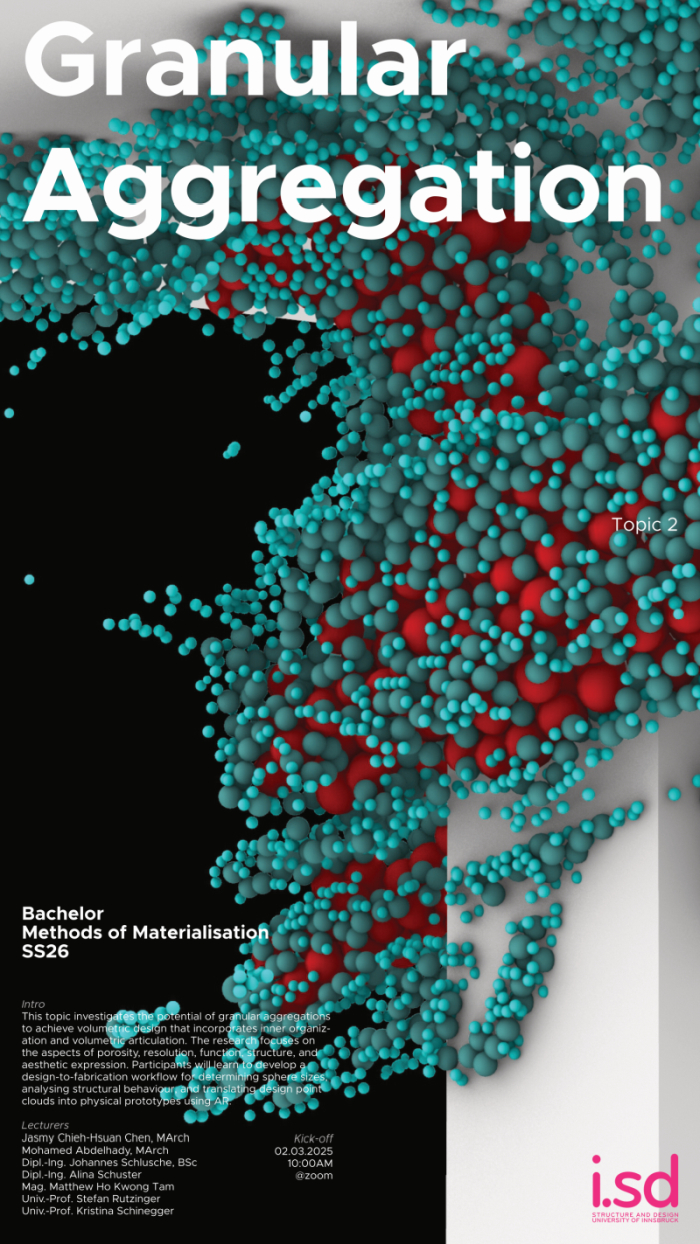
TOPIC 2 – Granular Aggregation (3D Point Printing) – Groups 8, 9, 10, 11
● Aggregation and construction principles
● Digital assistance in assembly
● Use of AR and HoloLens
This topic investigates the potential of granular aggregations to achieve volumetric design that incorporates inner organization and volumetric articulation. The research focuses on the aspects of porosity, resolution, function, structure, and aesthetic expression. Participants will learn to develop a design-to-fabrication workflow for determining sphere sizes, analysing structural behaviour, and translating design point clouds into physical prototypes using AR.
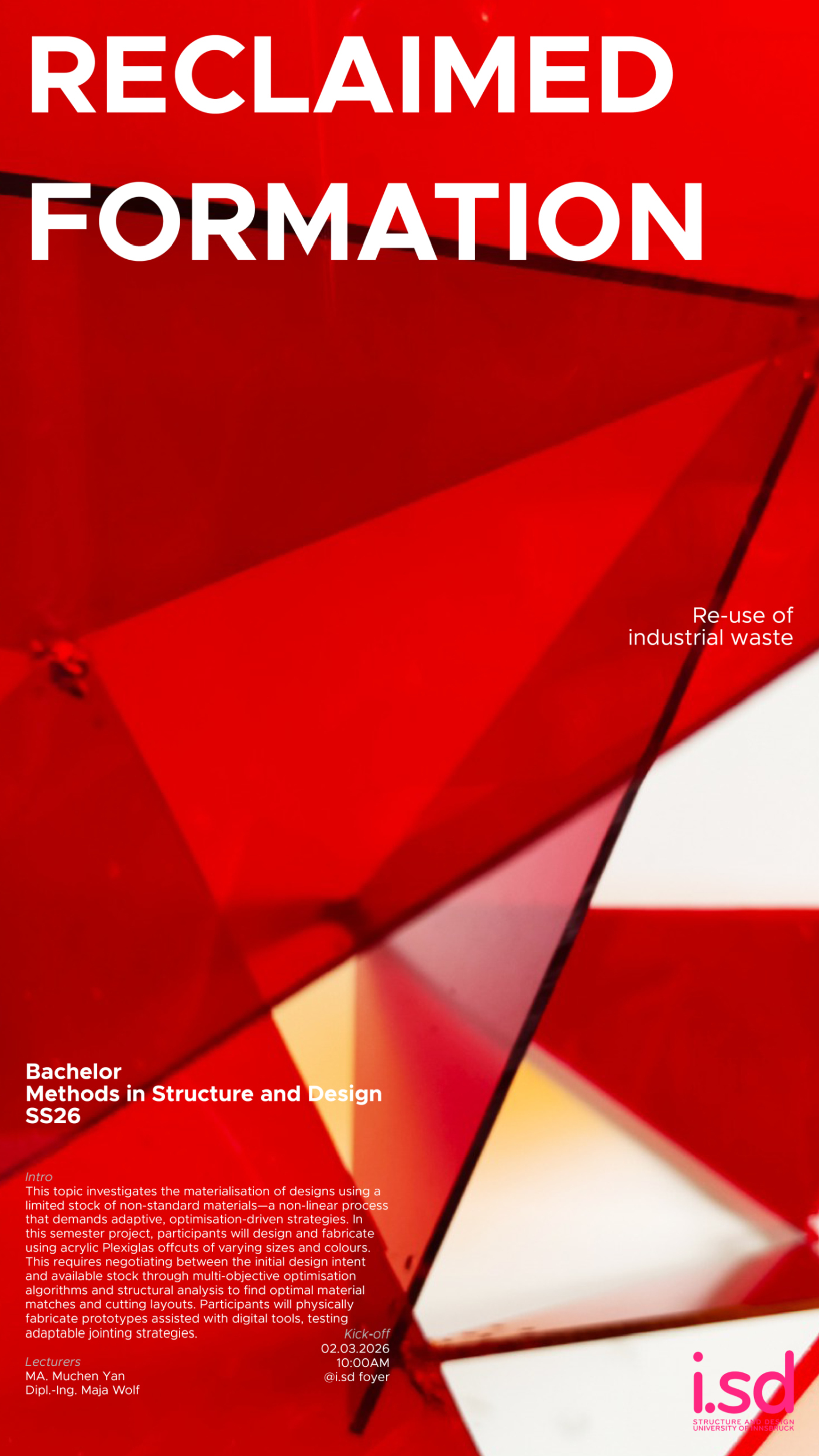
TOPIC 3 – Reclaimed Formation – Groups 4,5,6,7
● Re-Use von Industrieabfällen (insbesondere Kunststoffe)
● Entwurfskonzepte wie „Form follows Availability“
● Adaptive Joints + Digitale Montageunterstützung (AR in Assembly)
This topic investigates the materialisation of designs using a limited stock of non-standard materials—a non-linear process that demands adaptive, optimisation-driven strategies. In this semester project, participants will design and fabricate using acrylic Plexiglas offcuts of varying sizes and colours. This requires negotiating between the initial design intent and available stock through multi-objective optimisation algorithms and structural analysis to find optimal material matches and cutting layouts. Participants will physically fabricate prototypes assisted with digital tools, testing adaptable jointing strategies.